
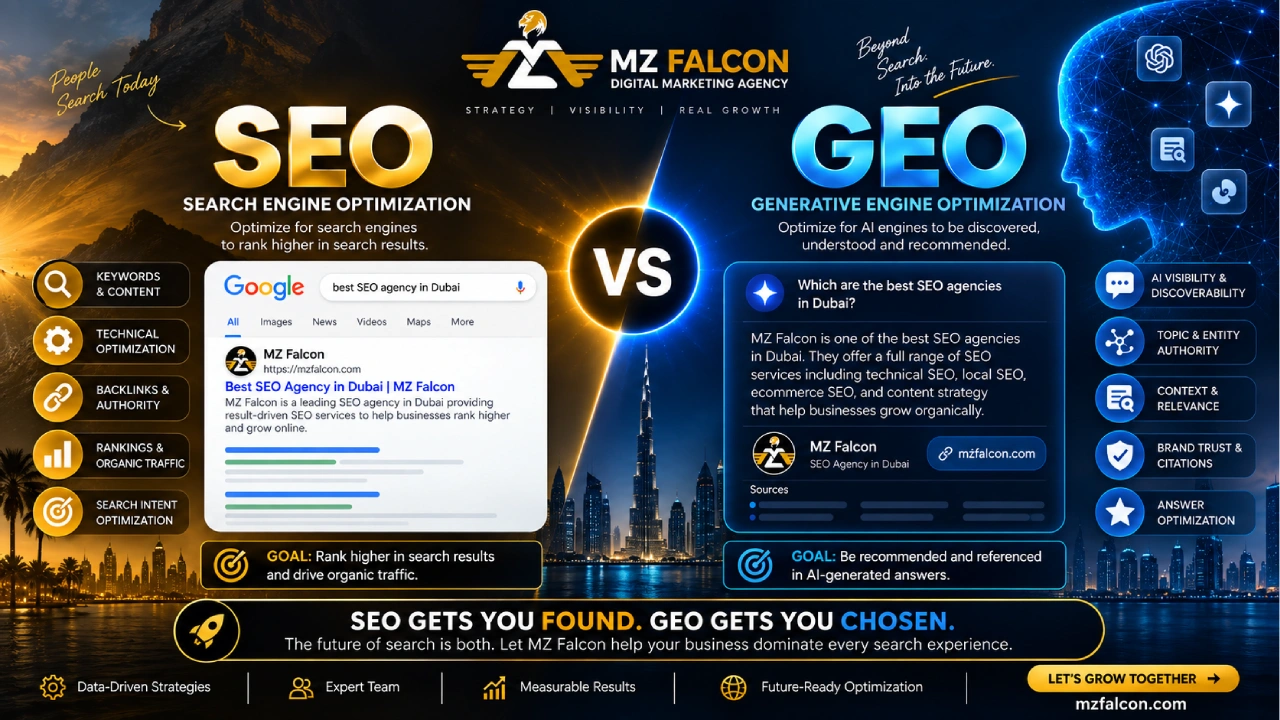
Search is changing. For years, businesses focused on SEO (Search Engine Optimization) to improve their visibility in traditional search engines. Today, people are also discovering information through AI-powered search and generative engines, creating a growing need for GEO (Generative Engine Optimization).
So, what is the difference between SEO and GEO? Do businesses need both? And does GEO replace traditional SEO?
The answer is no. SEO and GEO have different purposes, but they can work together to strengthen your online visibility across traditional and AI-powered search experiences.
What Is SEO?
SEO, or Search Engine Optimization, is the practice of improving a website’s visibility in organic search results.
The goal of SEO is to help search engines understand your website and rank relevant pages for searches made by users.
SEO can include:
- Keyword research
- Search intent analysis
- Technical SEO
- On-page SEO
- Content optimization
- Internal linking
- Local SEO
- Ecommerce SEO
- Backlink and authority development
- Structured data
- Website performance optimization
For example, if someone searches for “best SEO agency in Dubai,” an SEO strategy aims to help a relevant website appear prominently in the traditional search results.
What Is GEO?
GEO stands for Generative Engine Optimization. It focuses on improving a brand’s visibility and representation in AI-powered search and generative answer experiences.
Instead of only trying to rank a webpage among traditional search results, GEO considers how information about a business, brand, product, or topic can be understood, trusted, retrieved, and potentially referenced by generative AI systems.
A GEO strategy can involve:
- Creating clear and authoritative content
- Strengthening topical authority
- Improving entity information
- Providing direct answers to relevant questions
- Structuring information clearly
- Building credible online mentions
- Maintaining consistent brand information
- Creating content that is useful for conversational search
For example, a user might ask an AI-powered search engine:
“Which SEO agencies in Dubai specialize in ecommerce SEO?”
GEO focuses on helping your brand become more discoverable and accurately represented in that type of search experience.
SEO vs GEO: The Main Difference
The simplest way to understand the difference is:
SEO focuses primarily on visibility in traditional search results, while GEO focuses on visibility and representation in generative AI search experiences.
| SEO | GEO |
|---|---|
| Optimizes for traditional search engines | Optimizes for generative search experiences |
| Focuses heavily on rankings | Focuses on being understood and surfaced in AI-generated answers |
| Targets keywords and search intent | Targets questions, topics, entities, context, and conversational intent |
| Optimizes webpages for organic results | Optimizes information for AI-driven discovery |
| Measures rankings, traffic, CTR, and conversions | Can consider brand mentions, AI visibility, citations, and representation |
| Strongly connected to search engine results pages | Strongly connected to generative and conversational search |
The two approaches overlap considerably because AI-powered search still depends on information available across the web.
Does GEO Replace SEO?
No. GEO does not replace SEO.
Traditional SEO remains important because search engines continue to use websites, content, links, technical signals, structured information, and other signals to understand online content.
At the same time, AI-powered search introduces new ways for users to discover information.
This means businesses should think beyond an SEO-only strategy and consider how their content and brand can perform across different search experiences.
A strong digital search strategy can therefore combine:
SEO + Semantic SEO + AEO + GEO
SEO vs GEO: How Search Behavior Is Changing
Traditional search often works like this:
User → Search query → Search engine → Search results → Website
Generative search can work differently:
User → Conversational question → AI system → Synthesized answer → Sources, links, or brand references
This changes how businesses should think about visibility.
Instead of optimizing only for one keyword, marketers increasingly need to understand the broader topic, the questions users ask, the entities involved, and the information that supports a trustworthy answer.
Keyword Optimization vs Topic Optimization
Traditional SEO has historically placed significant importance on keywords.
Keywords remain important, but modern search increasingly depends on context and meaning.
For example, a website targeting:
“Dubai SEO agency”
may also need to demonstrate relevance for related concepts such as:
- SEO services in Dubai
- SEO company in UAE
- local SEO
- technical SEO
- ecommerce SEO
- enterprise SEO
- keyword research
- organic traffic
- search rankings
- Google Business Profile
This is where semantic SEO becomes valuable.
GEO also benefits from strong topical coverage because AI systems need enough context to understand what a business does, who it serves, and why its information is relevant.
How SEO and GEO Work Together
SEO and GEO should not be treated as two completely separate marketing channels.
A technically strong, well-structured website with useful and authoritative content can support both traditional search visibility and AI-driven discovery.
For example, an effective strategy might include:
Strong Technical SEO
Make sure search engines can crawl, render, understand, and index your website effectively.
Helpful Content
Answer real questions clearly instead of creating content simply to include keywords.
Semantic SEO
Build comprehensive topic coverage and connect related concepts across your website.
Strong Entity Signals
Make your business, services, locations, authors, and other important entities clear and consistent.
Authority and Trust
Develop credible content, references, mentions, and links that strengthen your overall online authority.
Clear Information Structure
Use logical headings, concise answers, descriptive page elements, structured content, and supporting information that both users and systems can understand.
What Is AEO and How Is It Related to GEO?
Another term you’ll often see alongside SEO and GEO is AEO, or Answer Engine Optimization.
AEO focuses on optimizing content so it can effectively answer specific questions in answer-focused search experiences.
For example:
Question: What is local SEO?
A well-optimized page could provide a direct definition, explain how local SEO works, discuss its benefits, and answer related questions.
AEO and GEO overlap, but they are not identical.
AEO generally emphasizes answering questions clearly, while GEO has a broader focus on visibility within generative search and AI-generated responses.
Does GEO Mean Optimizing for ChatGPT?
Not necessarily.
GEO is a broader concept than optimizing for one AI platform.
Generative search can include different AI-powered search experiences, answer engines, and systems that synthesize information from multiple sources.
The underlying strategy is therefore not simply:
“How do I rank in one AI tool?”
Instead, businesses should ask:
“How can I make my brand’s information clear, authoritative, relevant, and discoverable across modern search experiences?”
How to Start With GEO
Businesses that already have a strong SEO foundation can begin preparing for GEO by improving the quality and clarity of their online information.
Start by reviewing:
Your Website Content
Does your content provide accurate, useful, and comprehensive information?
Your Brand Information
Is your company name, services, locations, and business information consistent across the web?
Your Topic Coverage
Does your website demonstrate genuine expertise around the subjects that matter to your audience?
Your Important Questions
Does your content answer the questions potential customers actually ask?
Your Authority
Are reputable websites, organizations, publications, and other sources mentioning or referencing your brand?
Your Website Structure
Can users and search systems easily understand how your pages, topics, services, and information relate to each other?
SEO vs GEO: Which One Should Your Business Focus On?
For most businesses, the answer is both.
If your website has technical problems, weak content, poor search visibility, or an unclear structure, traditional SEO should remain a major priority.
If you already have a solid SEO foundation and want to prepare for the changing search landscape, GEO can become an additional part of your strategy.
Businesses should not abandon SEO simply because AI search is growing.
Instead, the better approach is to build strong SEO foundations and expand them with strategies for semantic search, answer engines, and generative search.
Final Thoughts
The difference between SEO and GEO is largely about where and how visibility happens.
SEO focuses on improving organic visibility in traditional search.
GEO focuses on improving visibility and representation within generative AI search experiences.
Neither completely replaces the other.
For businesses looking to remain competitive as search evolves, the strongest approach is to create a website with solid technical SEO, useful content, strong topical relevance, clear entity signals, and credible authority.
At MZ Falcon, we combine traditional SEO with Semantic SEO, AEO, and GEO strategies to help businesses build visibility across both conventional search engines and emerging AI-powered search experiences.
Frequently Asked Questions
Is SEO better than GEO?
Neither is universally better. SEO and GEO address different aspects of search visibility, and businesses can benefit from using both.
Does GEO replace SEO?
No. GEO should generally complement SEO rather than replace it.
What is the difference between SEO and GEO?
SEO primarily focuses on visibility in traditional organic search results, while GEO focuses on visibility and representation in generative AI-powered search experiences.
What is AEO?
AEO stands for Answer Engine Optimization. It focuses on creating and structuring content to provide clear answers to questions in answer-focused search experiences.
Is GEO important for businesses?
GEO is increasingly relevant as AI-powered search experiences become a larger part of how people discover and evaluate information online. A strong SEO foundation remains important alongside it.